

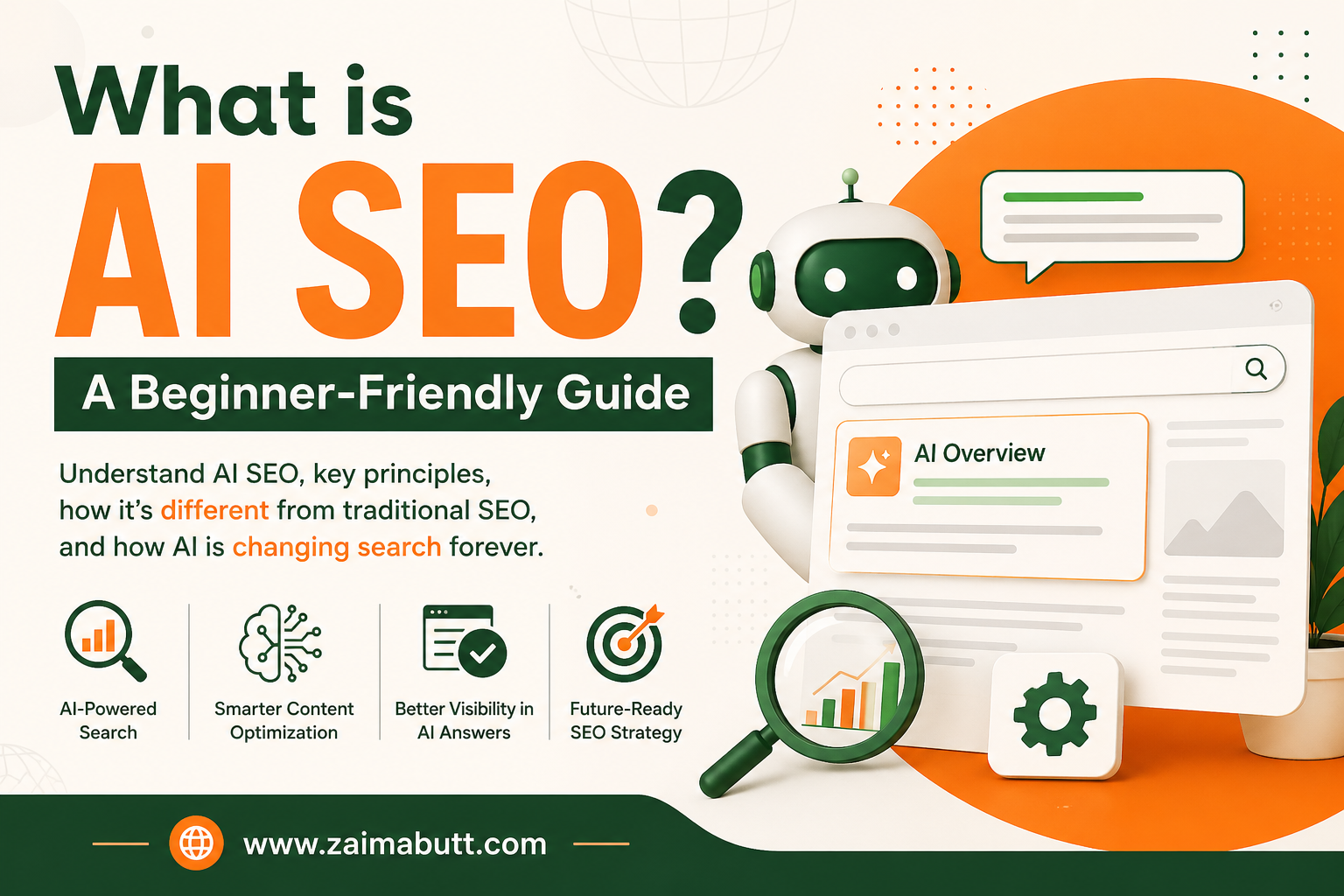
What is AI SEO?
Search is evolving faster than ever. With the rise of AI-powered search experiences like Google’s AI Overviews and generative answers, traditional SEO alone is no longer enough. This shift has introduced a new discipline—AI SEO.
Table of Contents
ToggleBut what exactly does that mean, and how should you adapt?
Let’s break it down in a clear, practical way.
AI SEO
AI SEO refers to the practice of optimizing your content not just for traditional search engine rankings, but also for AI-generated responses and search experiences.
In simple terms:
It’s about making your content understandable, trustworthy, and extractable by AI systems that generate answers directly on search result pages.
You might also hear people asking, what is ai seo called or what is seo for ai called. The terms are often used interchangeably with:
- AI Search Optimization
- Generative Engine Optimization (GEO)
- Answer Engine Optimization (AEO)
While the terminology varies, the core idea remains the same:
👉 Optimize content so AI systems can find it, trust it, and use it in answers.
Why AI SEO Matters in 2026
Search engines are no longer just listing links—they are answering questions directly.
This means:
- Fewer clicks to websites
- More competition for visibility inside AI answers
- Greater emphasis on authority and clarity
If your content isn’t optimized for AI-driven search, you risk becoming invisible—even if you rank traditionally.
What Elements Are Foundational for SEO with AI?
A common question is: what elements are foundational for seo with ai?
Here are the core pillars:
1. Topical Authority
AI favors sources that demonstrate deep expertise across a topic—not just one article.
2. Structured Content
Clear headings, logical flow, and semantic organization help AI extract answers easily.
3. Entity Optimization
AI understands concepts (entities), not just keywords. Your content should clearly define:
- Who
- What
- Why
- How
4. Trust Signals (E-E-A-T)
Experience, Expertise, Authoritativeness, and Trustworthiness are more critical than ever.
5. Contextual Relevance
Instead of keyword stuffing, focus on covering related subtopics naturally.
Is Optimizing Content for AI Search Different from SEO?
Another important question: is optimizing content for ai search different from seo?
The short answer: Yes—and no.
What’s the Same:
- Quality content still wins
- Backlinks still matter
- User intent is still central
What’s Different:
- Content must be AI-readable, not just user-readable
- Answers must be direct, structured, and extractable
- Authority across a topic matters more than isolated rankings
👉 Think of it this way:
Traditional SEO helps you rank
AI SEO helps you get selected
How AI SEO Works (Simplified)
AI systems analyze content differently than traditional algorithms. They:
- Break down your content into meaning (not just keywords)
- Identify entities and relationships
- Evaluate credibility signals
- Extract concise answers for users
This is why content that is:
- Clear
- Structured
- Insightful
…has a much higher chance of appearing in AI-generated responses.
Traditional SEO vs AI SEO
Traditional SEO and AI SEO are closely related—but their execution differs in key ways.
Traditional SEO focuses on:
- Ranking pages
- Keywords and backlinks
- Click-through rates
AI SEO focuses on:
- Answer visibility
- Context and meaning
- Content extraction
👉 Want a deeper breakdown?
Read the full guide here: [Traditional SEO vs AI SEO]
Core Principles of AI Search Optimization
To succeed in AI SEO, you need to align with how AI systems interpret content.
Key principles include:
- Writing in a clear, structured format
- Answering questions directly within content
- Building topical depth instead of isolated posts
- Using natural language instead of rigid keyword placement
👉 Explore the full framework here:
[Core Principles of AI Search Optimization]
How AI Changes Search Behavior
AI is not just changing algorithms—it’s changing how people search.
Users are now:
- Asking longer, conversational queries
- Expecting instant, summarized answers
- Clicking less and consuming more directly on SERPs
This shift means your content must:
- Deliver value quickly
- Anticipate follow-up questions
- Be comprehensive yet easy to scan
👉 Learn more about this shift here:
[How AI Changes Search Behavior]
Common Misconceptions About AI SEO
“AI will replace SEO”
No—SEO is evolving, not disappearing.
“AI content doesn’t rank”
Low-quality content doesn’t rank—regardless of how it’s created.
“Keywords don’t matter anymore”
They still matter, but context matters more.
The Future of AI SEO
AI SEO is not a trend—it’s the direction search is moving toward.
In the near future:
- Ranking alone won’t guarantee visibility
- Authority will outweigh optimization hacks
- Content ecosystems will outperform single posts
Final Thoughts
AI SEO is about adapting to a new reality where search engines act more like answer engines than directories.
If you focus on:
- Clarity
- Depth
- Authority
- Structure
…you won’t just keep up—you’ll gain a serious advantage.
What to Do Next
If you’re just getting started:
- Build topic clusters instead of random posts
- Focus on answering real user questions
- Structure content for readability and extraction
And most importantly—start early.
Because in AI-driven search,
👉 visibility goes to those who adapt first.